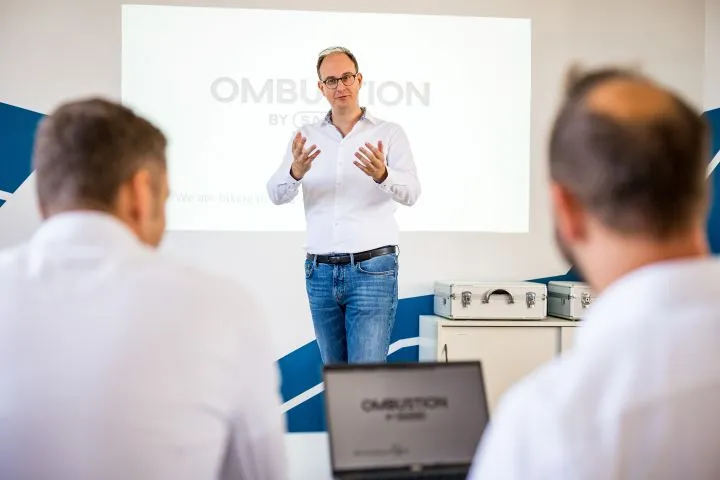
How can the industrial energy transition succeed while ensuring that process heat continues to be supplied reliably, economically and with low emissions? This is the question Dipl.-Ing. Phillip Schönberger from SAACKE will address in a presentation at Imperial College London.
On 9 September 2026, Imperial College London will host the 7th Clean Energy Science Lecture and Seminar of the FERF Combustion Interest Group. The event will focus on hydrogen as an energy carrier for industrial transformation.
Phillip Schönberger has been invited to speak on behalf of SAACKE. His presentation, entitled “Fuelling Industrial Decarbonisation – Hydrogen and Alternative”, will take place as part of the session “Hydrogen as a Fuel”.
Hydrogen as a key element of the industrial energy transition
For many industrial processes, electrifying the heat supply is not always technically or economically feasible. Alternative fuels such as hydrogen can therefore play an important role. At the same time, the use of H₂ presents new challenges for combustion technology, particularly due to its specific combustion characteristics and the requirements for safe, low-emission operation.
This intersection between the energy transition and industrial application is precisely where SAACKE’s expertise lies. The Bremen-based company develops industrial combustion systems for a wide range of fuels, with an increasing focus on future-ready solutions for hydrogen and other alternative energy carriers. Among other technologies, SAACKE offers burner systems capable of operating with hydrogen concentrations of up to 100%, as well as solutions for a wide range of industrial capacity requirements.
A project at the BMW Group plant in Leipzig demonstrates that these technologies can already be implemented in practice today. SAACKE hydrogen burners have been deployed there to replace natural gas with hydrogen in production applications and in the boiler house.
Connecting research and industry
The seminar provides an ideal setting for dialogue between scientific research and industrial practice. Imperial College London is extensively involved in research relating to clean energy, carbon capture and storage, and the decarbonisation of energy-intensive industries. Professor Paul Fennell, for example, conducts research into technologies for more efficient CO₂ capture and solutions for hard-to-decarbonise industrial processes.
Alongside Phillip Schönberger, the seminar programme features experts from organisations including Hydrogen UK, Imperial College London, ECOMB AB and the University of Nottingham. The event will conclude with the 7th Clean Energy Science Lecture by Professor Nilay Shah on “Opportunities and Challenges for Aviation E-Fuels”.
For SAACKE, the event provides a valuable platform for contributing practical industrial experience and continuing the dialogue on technologies for a more climate-friendly energy supply.
We look forward to the exchange in London and to insightful discussions on hydrogen, alternative fuels and the future of industrial process heat.